
Adams County Civil Docket Searches
Adams County splits its civil docket access by court. The Record Searches selector offers separate CaseLook routes. One route serves the Clerk of Courts. Others serve the Common Pleas Court, the County Court, and the Probate Court. A foreclosure, major civil claim, or domestic-relations matter belongs on the Common Pleas route. Small claims and evictions run through County Court. Probate keeps its own CaseLook choice and records counter.
Each CaseLook path opens with terms and a human-verification step. What search fields appear after that step is not documented. No one can promise a party-name filter, case-type menu, attorney field, or civil case-number format. Treat the route as a way to learn the court and case number. Need a date, a filing, or a full record confirmed? Call the clerk who keeps the case.
- Open the official Adams County Record Searches selector and identify the division that received the civil matter.
- Choose Common Pleas, County Court, or Probate CaseLook to match that division.
- Read the notice, accept the terms, and complete the required human-verification screen in a normal browser.
- Use the available record to capture the court and court-assigned case number, without assuming an unpublished local format.
- Ask the relevant counter for a current setting, docket or register, plain copy, or certified copy as needed.
The official County Court forms page gathers the local civil forms used in County Court practice. It is a court-designated source.
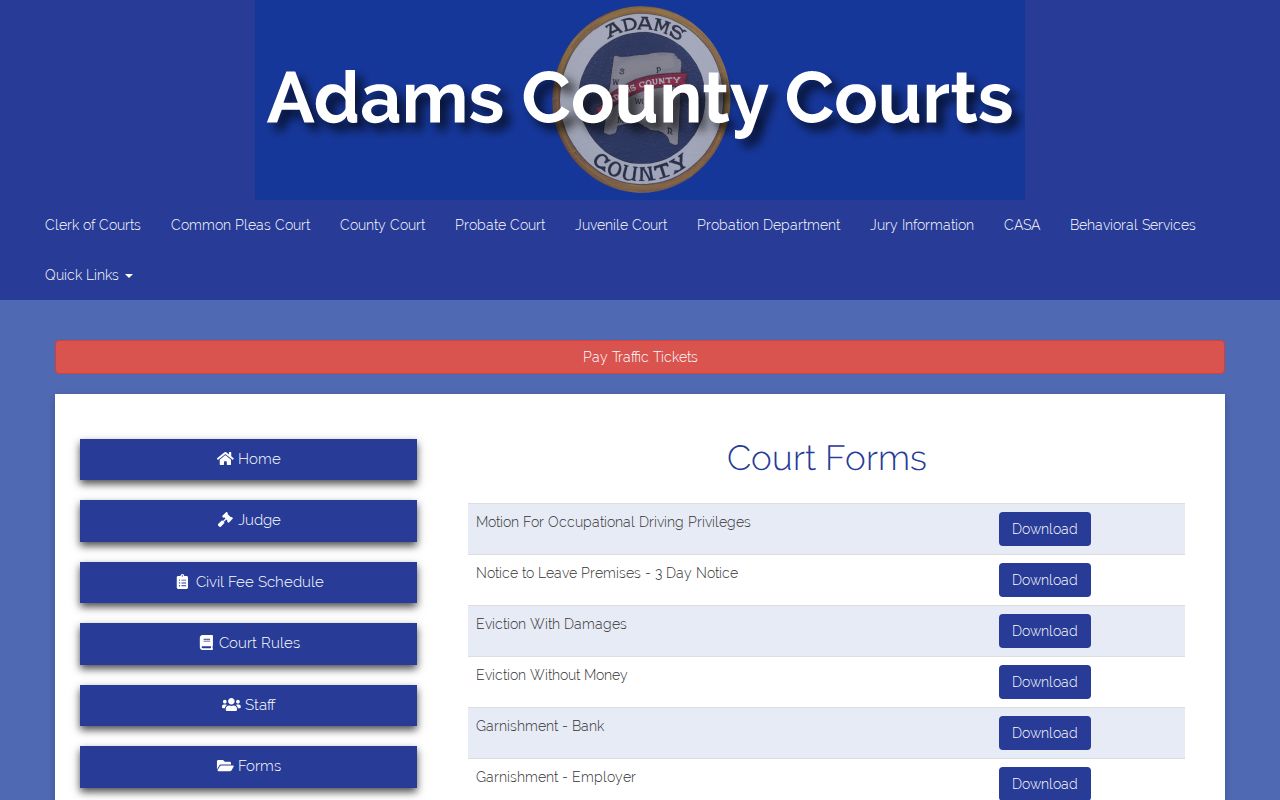
Those forms support a filing. They do not replace the court-specific Record Search path, which is the tool for actually locating a civil docket.
Adams County Civil Docket Routing Above $15,000
How much is at stake decides where an Adams County civil case belongs. The Common Pleas General Division hears civil matters exceeding $15,000. Contracts, personal injury, business disputes, real-estate issues, and foreclosures all land there. County Court covers civil recovery through $15,000. Its fee schedule lists a small-claims track through $6,000. Subject matters too. A case may belong elsewhere instead. The Common Pleas Domestic Relations division or the Probate division could hold it.
The routing matters for a docket search. Pick the wrong CaseLook route and the right case can come back as nothing. Match the court first, then search.
Ohio Revised Code Chapter 1907 sets the County Court jurisdiction framework. It stands behind these Adams County routing rules.
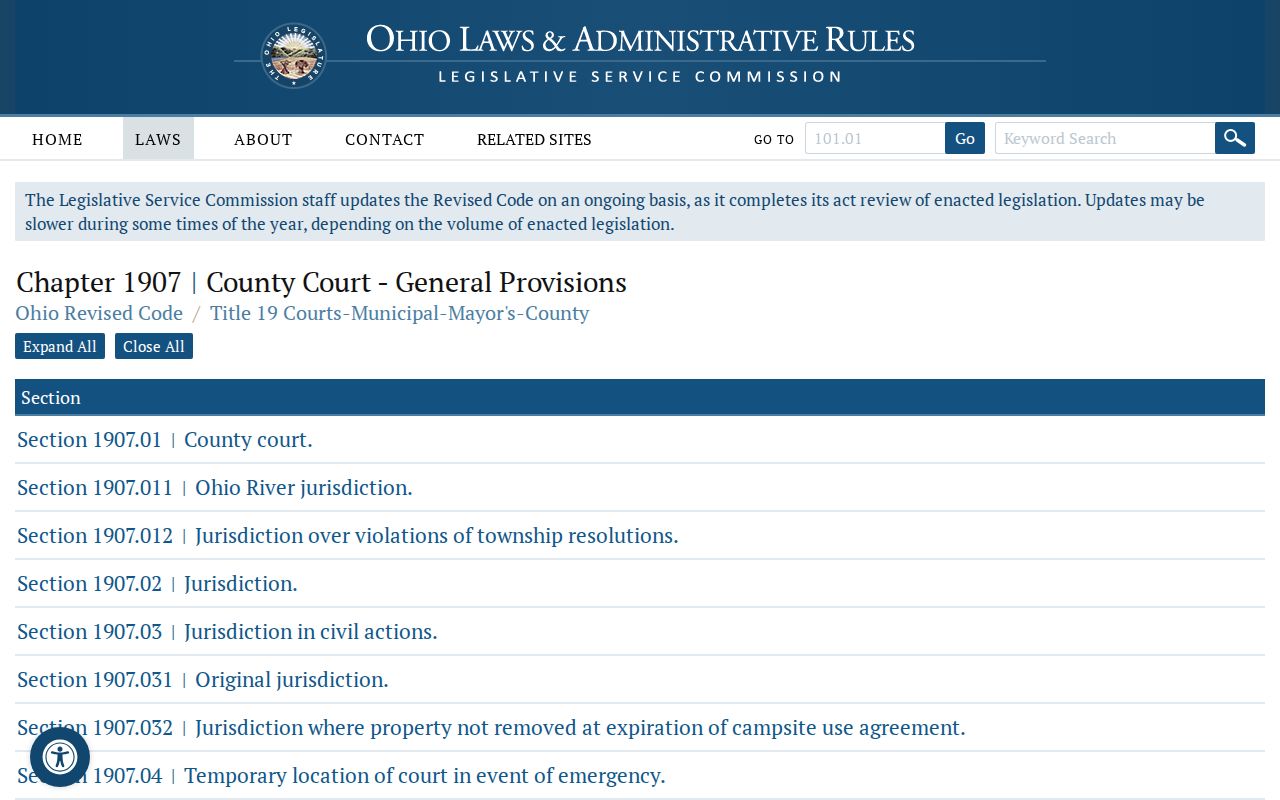
That statute explains the structure. One county, several civil docket routes, and no single combined public portal.
Civil Dockets: What They Show
The Adams County Clerk of Courts files, dockets, indexes, and preserves the pleadings. That duty covers every case. Local rules define the official electronic court record. It means documents electronically filed, accepted, and docketed by the Clerk. In plain terms, the docket is the chronological index of case activity. A pleading, order, or judgment is a document inside the case file. A certified copy comes only from the custodian who issues it.
CaseLook sits behind a verification step. Nothing here claims a particular screen shows party roles, service details, attachments, balances, or case outcomes. Treat these as record concepts. Confirm what a specific docket displays with the clerk.
| Case number | The identifier assigned by the court, used to locate the case and to request the docket or a copy. Adams has not published a civil number format to assume. |
|---|---|
| Case caption | The formal title of the civil matter, used on notices and other court papers. |
| Pleading or filing | A formal case document received into the court record; a filing does not by itself establish a ruling. |
| Motion and proposed entry | A request for court action and, where required, a draft entry supplied for review. |
| Journal entry or judgment | A court entry reflecting an order or determination in the case. |
R.C. 2303.12 describes the Common Pleas clerk’s docket and case-file recordkeeping duties.
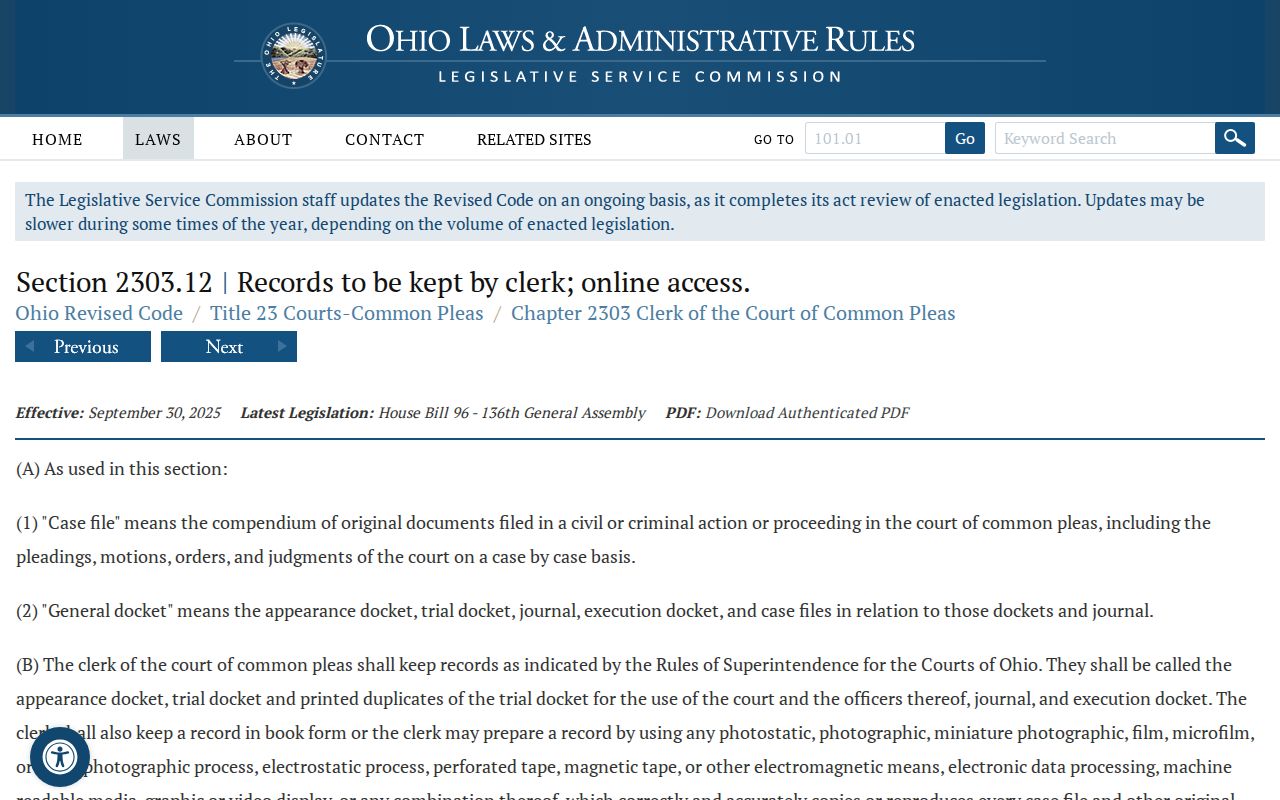
That recordkeeping rule draws the real line. Finding a case online is one thing; getting a verified court document from the Clerk is another.
Adams County Civil Docket Entry Meaning
Local words carry exact meanings on a civil docket. Filed means the document reached the court record. Docketed means the Clerk entered it on the case record. Neither word tells you a judge granted anything. A motion is a request for court action. Common Pleas Local Rule 014 generally requires a supporting memorandum with it.
For fact-based claims, that rule also demands an affidavit or sworn certification. A proposed entry is only a draft submitted for the court to consider. A later journal entry records what the court actually did. A motion, a hearing setting, and a judgment are separate steps, not interchangeable labels.
The court-designated Common Pleas forms and checklists page lists the local materials. They are used across its divisions.
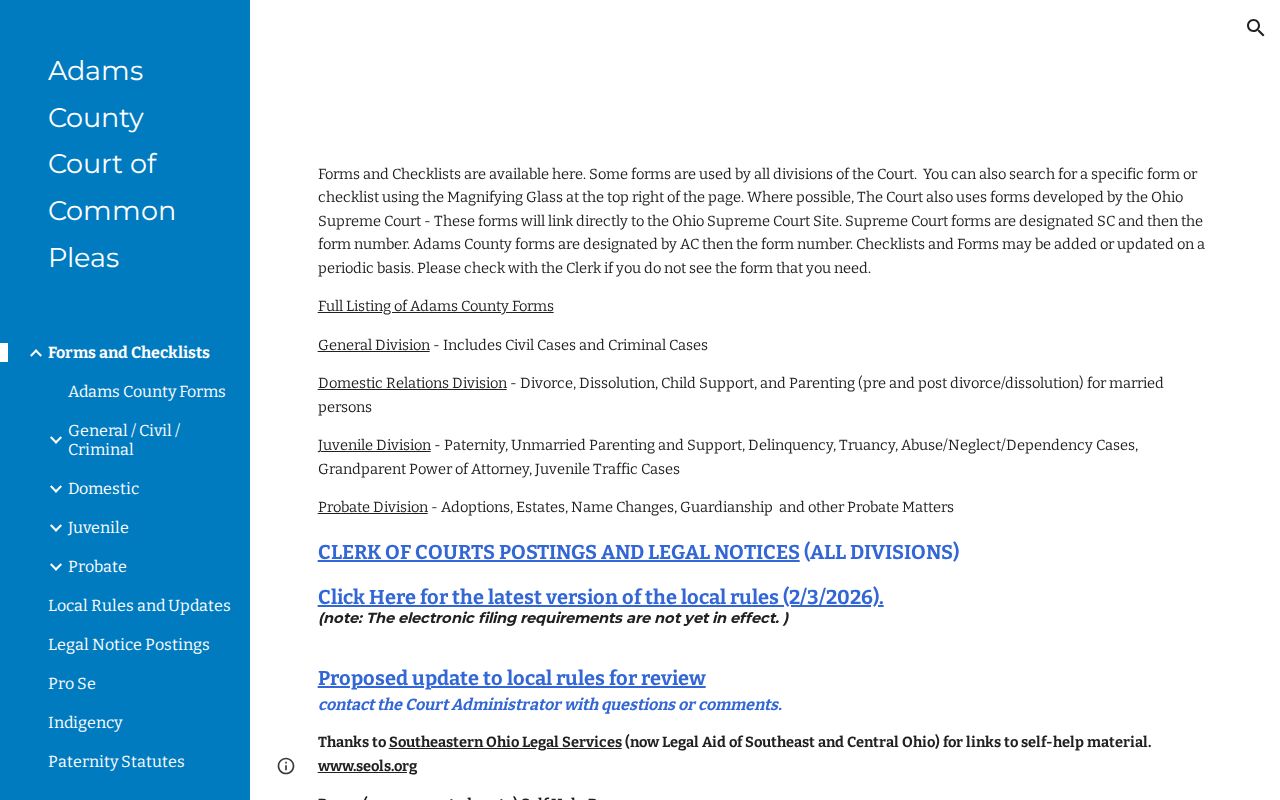
Those materials make the same point. A filed request and a court entry resolving it are two distinct events in the record.
What Cases Fill the Civil Docket
Two things fill the Adams County civil docket: the dollar amount and the subject. Common Pleas General Division carries the larger general civil docket. County Court handles lower-dollar civil work within its jurisdiction. Domestic Relations and Probate are separate divisions. Their cases need the matching route, even though they sit in the same county courthouse system.
- Common Pleas general civil matters exceeding $15,000, including contracts, personal injury, business, real-estate issues, and foreclosures.
- County Court small claims through $6,000 and regular civil matters within County Court jurisdiction through $15,000.
- County Court forcible entry and detainer matters, the statutory term used for an eviction-type action.
- Domestic Relations matters such as divorce, dissolution, support, custody, and visitation.
- Probate matters including estates, guardianships, trusts, adoption, name changes, and marriage issues.
The County Court civil fee schedule breaks out the small-claims, regular civil, and forcible-entry-and-detainer tracks.
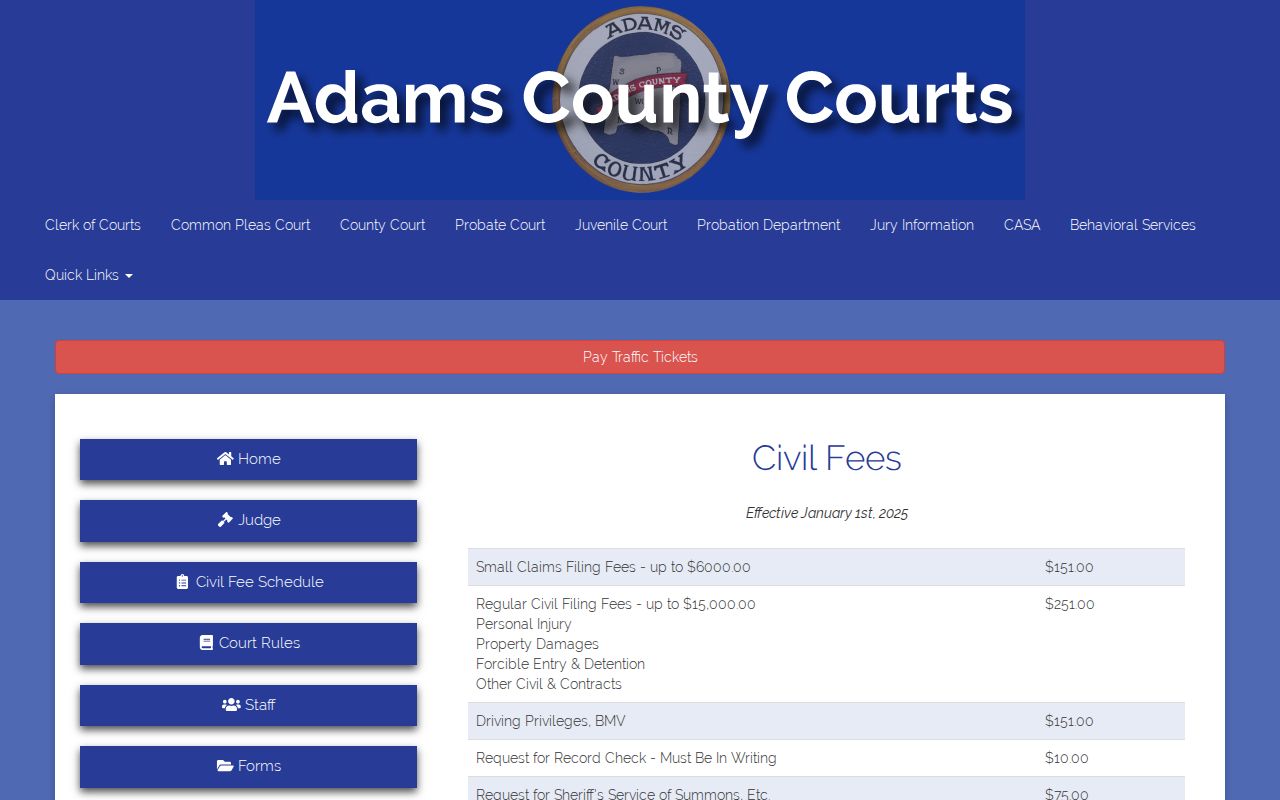
Those published categories show why court and claim type come first. No single civil docket route covers them all.
Adams County Civil Docket Counterclaims and Transfers
Money can move a case. The $15,000 line matters for where an Adams County dispute proceeds. If a County Court defendant files a counterclaim that exceeds $15,000, the case must be certified to Common Pleas. The original papers travel with a certified journal-entry transcript. So the docket you first find in County Court may no longer hold the live file.
An older County Court entry is not always the end of the trail. Start with the court that received the case. Then use the court-assigned case number to ask where the file sits now. Direct any request for official copies to the court currently holding the record.
Hearings on the Civil Docket
Adams County posts no standalone daily or weekly civil calendar. CaseLook can help you identify a case, but the county warns its entries lag by at least 24 hours or longer, so it cannot confirm a current hearing. For a Common Pleas motion hearing, the Assignment Commissioner gives you the date and time, set at the first available slot that fits the docket.
Local Rule 014 shapes how that happens. A motion needing a hearing comes with a proposed entry whose hearing-date fields are blank until a time is assigned. Motions are heard in the order set. Expect a matter to run more than 15 minutes? Tell the Assignment Commissioner in advance. For County Court civil settings, the clerk in Room 25 at 937-544-2011 is the place to confirm.
A continuance takes more than a request. The court itself must authorize it. The usual Common Pleas rule asks for a motion and memorandum at least 14 days before the hearing or trial, with a definite new date, coordinated in advance, placed in the entry.
Adams County Civil E-Filing Status
Adams Common Pleas local rules describe a court-designated E-File System. The February 2026 update is clear. Electronic-filing requirements are not yet in effect. The court offers no public e-file login or public civil-document portal. What exists today is court-specific CaseLook. Back it up with the counter, a phone call, or a written request whenever verification matters.
That status affects anyone hunting a brand-new civil filing. An attorney e-filing product is not a public docket viewer. Do not treat it as one. A same-day absence on CaseLook is not a final answer either. The court's posted delay warning plus the counter fallback form the county-specific path for now.
Who Can See Civil Dockets
Ohio Superintendence Rules 44 through 47 govern access to covered court case documents. This is not a generic public-records request rule. Those rules define court records broadly. Pleadings, motions, orders, judgments, journals, dockets, and indices all count, subject to stated exclusions. Court records are generally presumed open. Still, the rules protect personal identifiers and permit access restrictions through a defined process.
Public access does not mean every item is open. Restricted or exempt documents, protected information, and some family or juvenile material may never appear as ordinary public content. A court may rely on redaction, direct-access-only limits, time-limited restrictions, generic descriptions, or initials. So a thin web result is not proof the case is missing. Ask the record keeper which access rule applies.
Key Rules:
Ohio Sup.R. 44 defines court records and covered case documents, including dockets and indices, subject to exclusions.
Ohio Sup.R. 45 presumes covered court records open while protecting identifiers and allowing restrictions by rule.
R.C. 2303.12 requires Common Pleas clerks to keep docket and case-file records and provides specified online-docket access.
Adams County Civil Docket Copies by Counter
Once you find the case, name what you want. It might be the docket or register, a plain document copy, or a certified copy. Common Pleas records go through the Adams County Clerk of Courts in Room 207. County Court civil records live at Room 25. Probate runs its own Room 221 counter. The matching counter matters. Each division publishes its own fee information and keeps its own files.
Common Pleas prices ordinary copies at $0.25 per page. Certified copies run $1 per page. County Court lists certified copies at $2 and written record checks at $10. Those amounts say nothing about whether every case document is public or online. The court's access rules and the current custodian still control. The Probate fee schedule is the official source for Probate copy and certification charges.
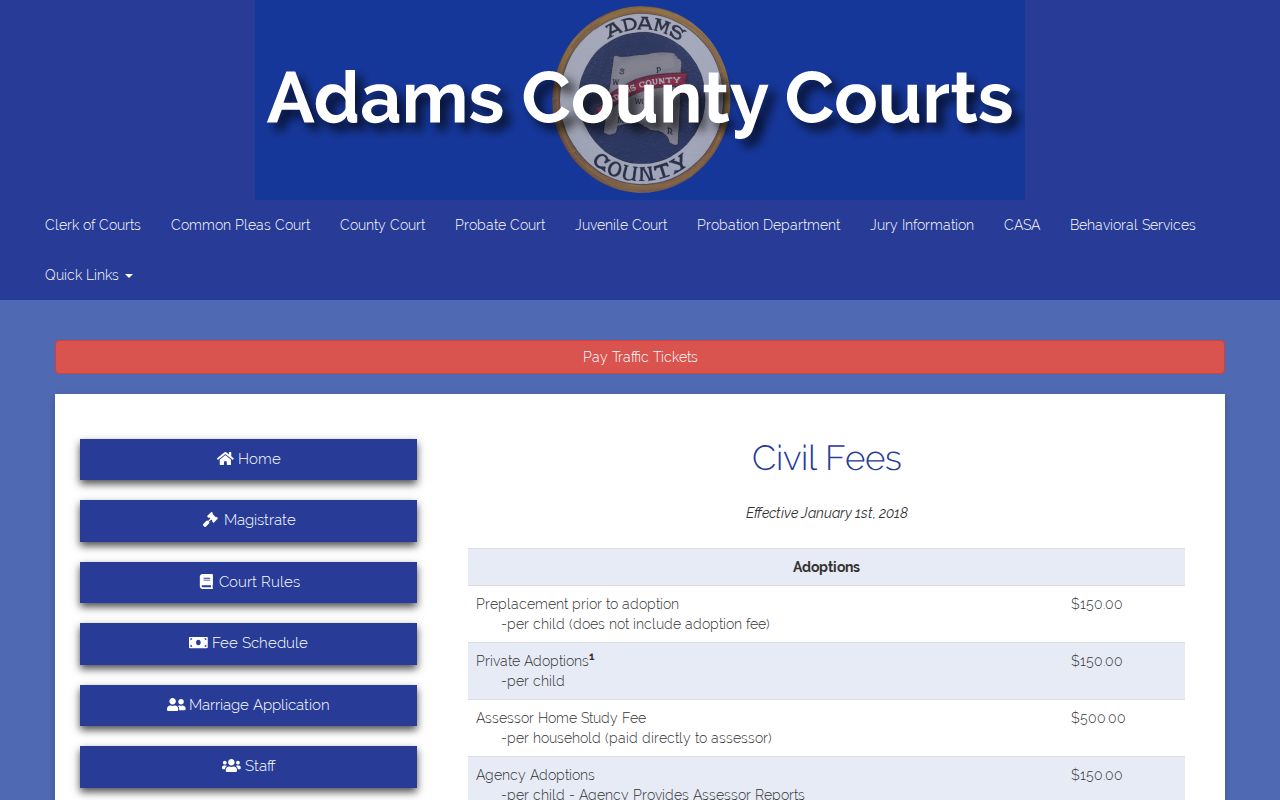
That separate schedule shows why each civil docket request belongs with the division keeping the case. Fees, forms, and copy rules differ counter to counter.