
Adams County Criminal Docket Searches
Adams County offers separate CaseLook routes for each court. All of them are reached through the official Record Searches selector. For an adult felony trial docket, go to Common Pleas CaseLook first. Misdemeanor and traffic matters sit in County Court CaseLook. There is also a Clerk route. The court that received the case is still the better starting point. Ohio has no public statewide portal for trial-court dockets by name and case number. The county route is the way in.
The public gateway does not document the order of search fields after verification. Do not assume an undocumented name, attorney, date, or code filter. Treat the result as a locator for the court and the court-assigned case number. For a current setting, a date confirmation, or a court-stamped record, follow up. Ask the office that keeps the case.
- Open the official Adams County Record Searches selector and choose the court that received the criminal matter.
- Read the CaseLook notice, accept its terms, and complete the interactive human-verification step in a normal browser.
- Use the available record to identify the court and court-assigned case number; Adams has not published a safe case-number pattern to assume.
- Check the case record for the documented event or setting, allowing for the county’s stated posting delay.
- Contact Room 207 for Common Pleas or Room 25 for County Court when a setting or certified copy needs confirmation.
The Common Pleas CaseLook notice is the official gateway, and it walks you through acceptance and verification before any search.
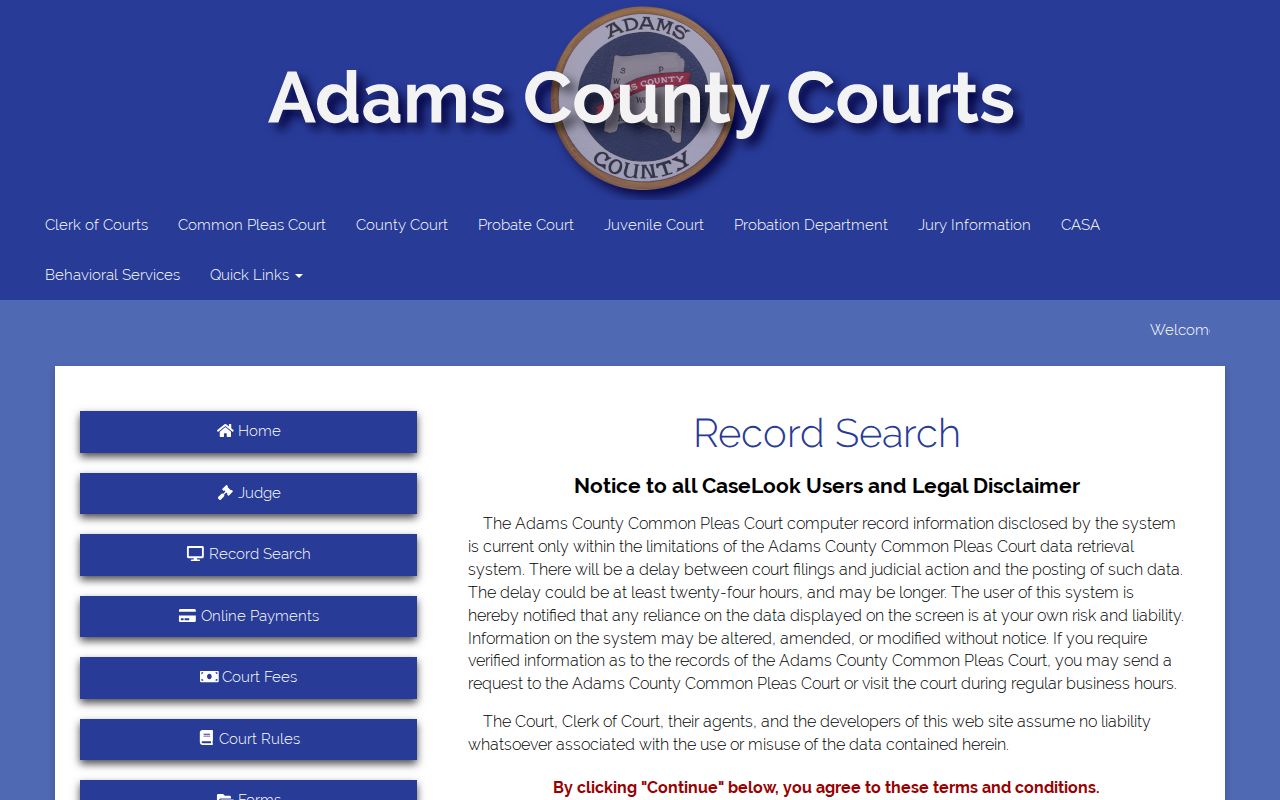
The notice warns that computer information can lag behind filings or court action. That warning should shape how you use any Adams County criminal docket search result.
Adams County Criminal Docket Delay
The CaseLook notices for the Clerk and Common Pleas routes carry a warning. Displayed data can run at least 24 hours behind filings or court action, and it can be modified without notice. So a missing entry is not proof of anything. Check the delay before drawing a conclusion from a recent omission. A same-day hearing, a new entry, or a just-filed request needs confirmation. Contact the right office.
No statewide portal exists as a second source when the local route looks stale. The practical fallback in Adams County is court-specific. Call, write, or ask in person at the counter that keeps the case. For a Common Pleas motion setting, the Assignment Commissioner can confirm the date and time at 937-544-8719 once the case is identified.
Criminal Dockets: What They Show
Adams County labels its public web route a Record Search. The Clerk's job is broader: file, docket, index, and preserve case materials. Local rules back a careful reading of a docket as the chronological court record or index. It is not a substitute for every document in the file. The table below sticks to locally documented record terms. It does not guess at a CaseLook screen layout.
| Case number | The court-assigned identifier used to locate the matter and request a record. Adams County has not published a criminal prefix or format to assume. |
|---|---|
| Case caption | The formal case title used on court notices and filings. |
| Filed and docketed entry | A filing has been received into the record; docketed means the Clerk has entered it in the case record. |
| Motion and memorandum | A motion asks the court to act. Common Pleas Local Rule 014 generally requires a supporting memorandum. |
| Hearing or journal entry | A hearing has a setting at a specific date and time; a journal entry reflects a court act or order. |
Adams County Criminal Docket Terms
A few local terms explain more than any code list could. A filed item has entered the court record, but filing alone is not a ruling. A docketed item is one the Clerk entered. A journal entry reflects a court act or order. A disposition resolves a charge or case. Its exact effect belongs in the official entry.
- Setting
- The date and time assigned for a hearing or other court event.
- Continuance
- A court-approved postponement of a setting, rather than a change created by the request alone.
- Certified copy
- A copy certified by the custodian for an official purpose, distinct from an online result.
The Clerk of Courts Legal page names the office that keeps the Common Pleas legal record.
That clerk role matters. Read any docket term alongside the actual entry or certified copy the office holds.
Criminal Case Stages on the Docket
A felony can cross two local courts. County Court may hold a preliminary hearing and bind over an alleged felony. Common Pleas then hears the serious adult criminal case at trial-court level. Once there, expect a full trail. Motions, scheduled hearings, continuance papers, journal entries, sentencing activity, and an appeal record can all appear in the court docket.
Docket flow: County Court preliminary hearing › bindover where applicable › Common Pleas felony proceeding › motion or hearing setting › journal entry or disposition › Fourth District appeal record if an appeal is filed.
A stage label alone does not settle current status. Adams publishes no live docket-code legend, so codes behind CaseLook are not explained on the public side. Identify the case first, then verify any material entry with the office that keeps it.
Adams County Criminal Docket Settings and Continuances
Common Pleas motions that need a hearing fall under Local Rule 014. It requires a supporting memorandum and a setting process. The Assignment Commissioner assigns a date and time. That goes in the first available slot that fits the docket. Anything expected to run more than 15 minutes needs notice so time can be reserved. Motion hearings proceed in setting order.
A continuance request does not move the date by itself. Adams rules demand court authorization. That normally means a motion and memorandum filed at least 14 days before the hearing or trial unless there is an emergency or sufficient cause, plus a definite coordinated new date stated in the entry. The local standard is one continuance per party per case. Later requests need extreme circumstances.
The Common Pleas fee schedule sets out copy and certification charges. The web search itself only locates cases for free.
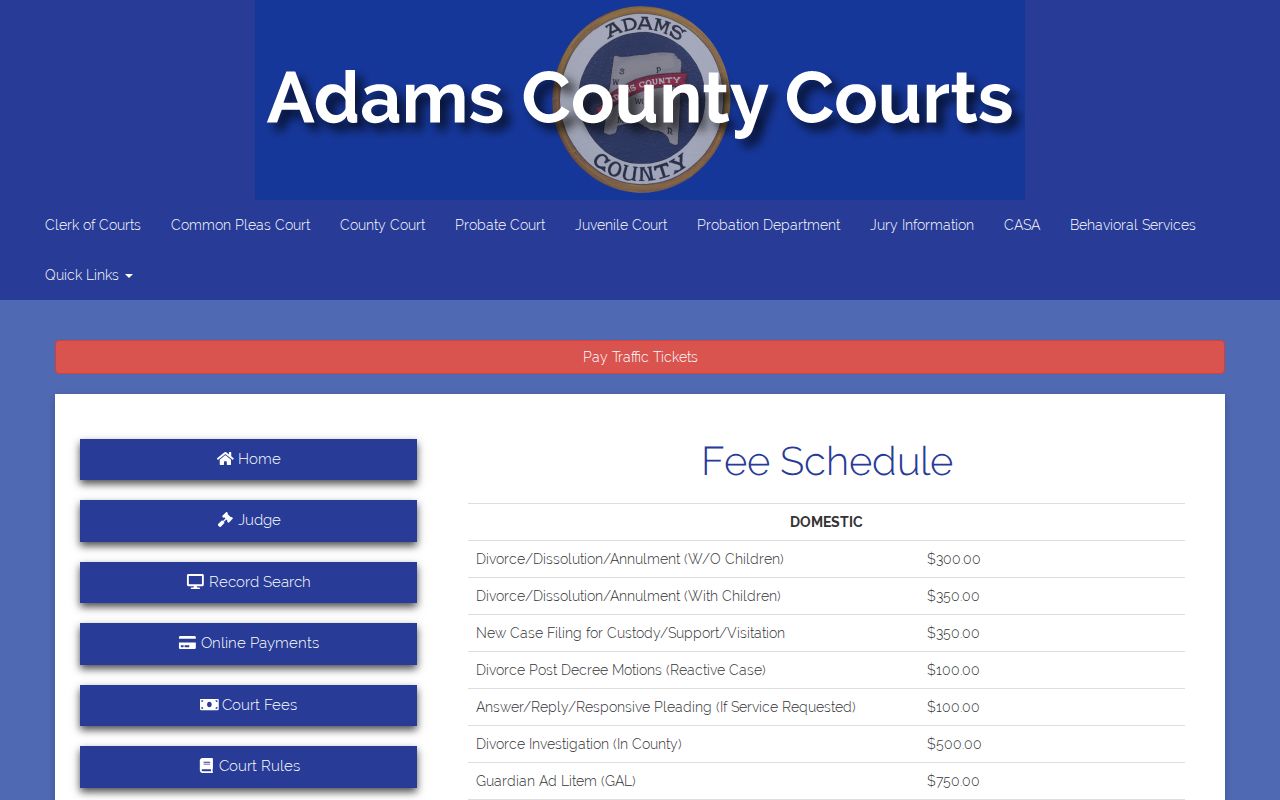
Need a setting to stand on its own? Get a certified copy. The clerk of the office that keeps the case is the one who issues that official version.
Adams County Criminal Docket Courts
Adams County splits its criminal work between two courts. Felony trials belong to the Adams County Court of Common Pleas. Its General Division hears the serious adult charges. The Adams County Court takes misdemeanors and traffic cases, and it can also handle the early felony stage. That split drives any criminal lookup. A felony trial docket sits with Common Pleas, while a misdemeanor docket sits with County Court. For records, go to the right counter. Common Pleas legal records live with the Adams County Clerk of Courts in Room 207, at 937-544-2344. County Court records sit with the Room 25 clerk, at 937-544-2011. The Clerk also serves the Fourth District on appeals. But an appeal record is a separate thing from the local trial docket. It never substitutes for one.
Adams County Criminal Docket Copy Choices
CaseLook finds cases; it is not the certified record. Once you have the right court and case number from the search, tell the keeper of the record exactly what you want. That could be a docket or register, a plain copy, or a certified copy. Name the court in your request. Common Pleas and County Court run separate counters with their own published fees. Common Pleas charges $1 per page for certified copies. County Court charges $2. Those are certification prices only, not a promise that anything sits online or is open to all. For a current setting, confirm the date with the court itself. An older web entry can lag behind the real docket.
Access Rules for Criminal Dockets
Access to court case documents runs under Ohio Superintendence Rules 44 through 47. The presumption is that court records are open. Still, the rules carve out personal identifiers, exempt documents, restricted documents, and protected juvenile information. A court can redact or limit direct access. It can impose a time-limited restriction, or use generic descriptions and initials. It takes those steps when that is the least restrictive way to protect information. Adult cases carry one more limit. A sealed or expunged record will not appear as an ordinary public-docket result. The county's online notices also carry a caveat. Displayed data is not verified. A thin result proves nothing. It does not mean no case exists, nor that unrestricted material should be there. Ask the office that holds the case about the proper access path.
Key Rules:
Ohio Sup.R. 44 defines court records and case documents, including dockets, subject to listed exclusions.
Ohio Sup.R. 45 presumes court records open while allowing identifier protection and court-ordered restrictions.
R.C. 2953.32 sets the adult sealing and expungement process for covered convictions and bail forfeitures.
The Ohio sealing statute sets out the adult process.
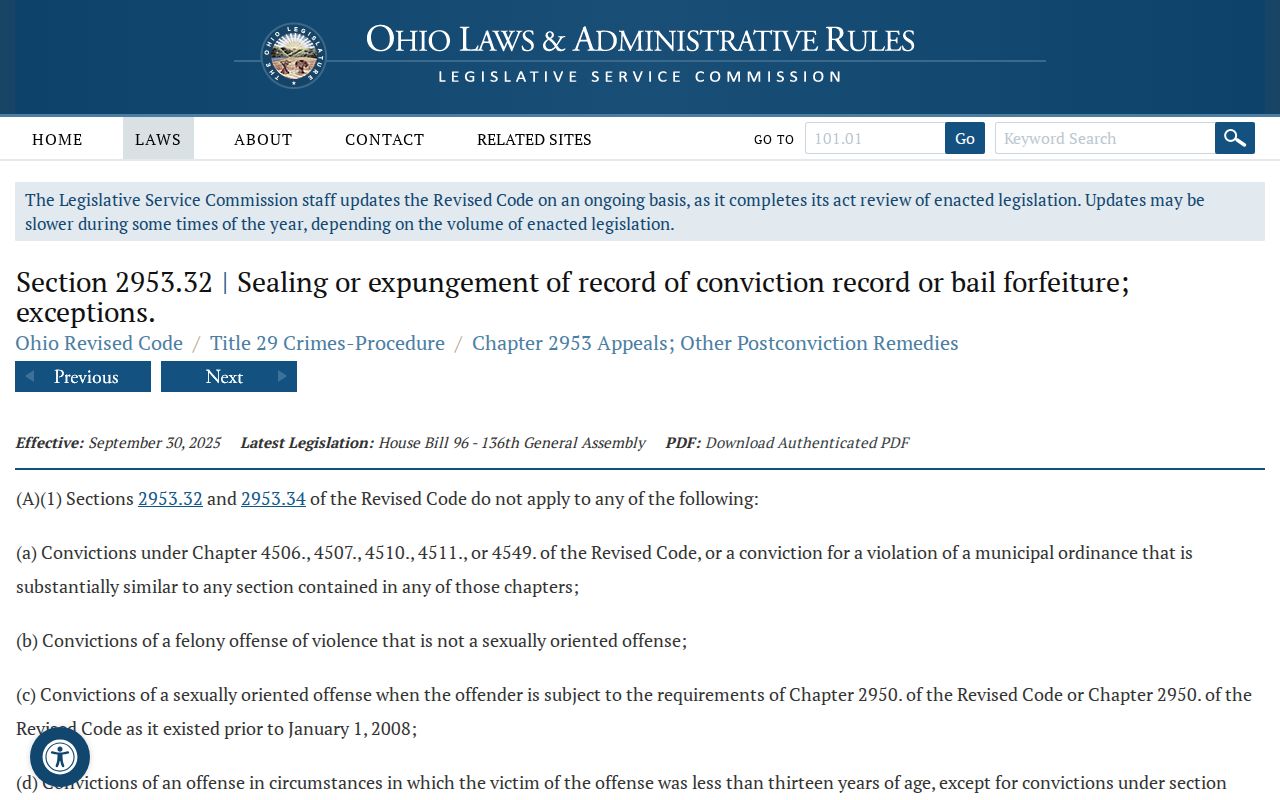
Read it there. The statute explains why a restricted criminal matter goes through the court and Clerk, not through an ordinary public result.
Adams County Juvenile Docket Limits
Juvenile cases follow their own access rule. Delinquency and juvenile traffic work never travel the same path as adult criminal dockets. The Adams Juvenile Court cites confidentiality. It states that it cannot give specific case information to the general public. Its records route and counter sit apart from the adult Common Pleas General and County Court criminal channels. Even so, the juvenile division belongs to the county courthouse court system. Ohio law treats juvenile sealing separately too. A searcher weighing a public CaseLook route against contacting the Juvenile Court about authorized access faces a real choice. Make that choice with the split in mind. One warning: a missing juvenile result is not a failed adult criminal search. The two dockets simply do not mix. For the sealing authority behind this framework, R.C. 2151.356 is the controlling statute.
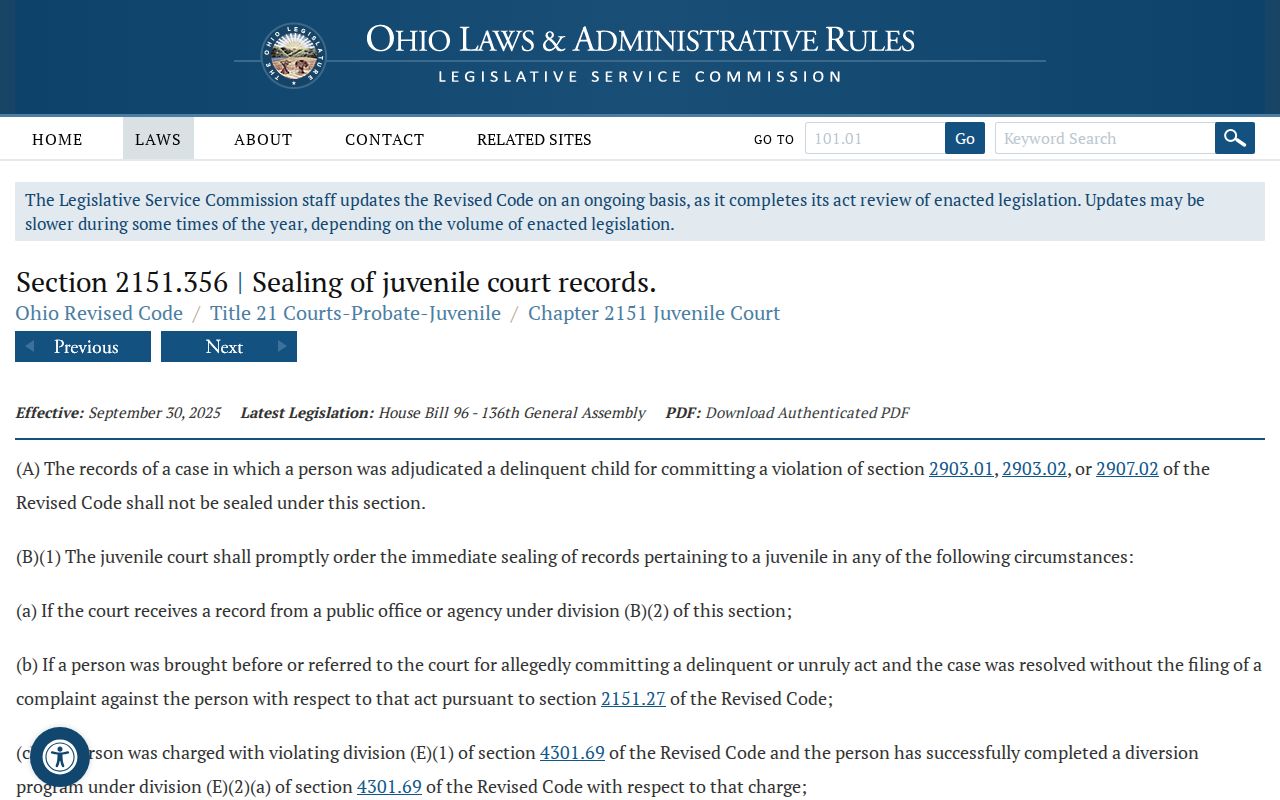
That statute is why the Adams Juvenile Court keeps specific case information separate and confidential.